


In a converting plant, a defective roll is rarely detected where it is produced. It appears later: on the laminator, in the printing press, or, worse, at the customer’s facility, when a roll is returned with its layers shifted. When the source is traced back, it often ends up in the same place: the tension at which the material was unwound, slit, and rewound.
Tension is the least visible parameter in the process and, for that reason, the most underestimated. A worn knife can be seen; incorrect tension is only noticed in the final result. This article reviews how tension behaves in a plastic film slitter rewinder, what defects occur when tension is lost, and which machine features should be evaluated to control it.
What Is Tension Control and Why Does It Matter More Than Speed?
In practical terms, tension is the force used to pull the material along the machine. However, what the film actually experiences is not the total force, but the stress per unit of cross-sectional area: the same force applied to a thinner or narrower film produces greater stress. This is why a setting that works for a thick material may stretch, deform, or even break a thin one.
This explains a familiar situation on the production floor: changing the material or gauge requires reviewing the tension, even when the width and speed remain the same. It also explains why increasing speed without readjusting the tension often causes problems. During acceleration and deceleration, the inertia of the master roll on the unwinder and of the rolls being formed on the rewinder introduces tension variations. A machine that compensates effectively for these variations maintains stable rewinding; one that does not transfers the error to the finished roll.
Every Material Requires a Different Tension
Not all films respond to stretching in the same way. Polyethylene is relatively soft and deforms easily; PET and BOPP are more rigid and can withstand higher tension before deforming; cellophane, laminates, and coated materials have their own specific characteristics. Gauge, surface finish, and the condition of the master roll also play a role.
Therefore, tension control cannot be based on one “average” value for the entire production process. The proper approach is to define tension according to material and gauge, start with the film supplier’s data, validate the settings through testing, and document the recipe that worked. A machine that allows these parameters to be configured and repeated reduces dependence on each operator’s individual judgment, which in many plants is the main source of variation between shifts.
The Most Common Defects and Their Causes
Almost every rewinding defect can be interpreted as a tension-related issue.
| Defect | What It Is | Common Causes |
|---|---|---|
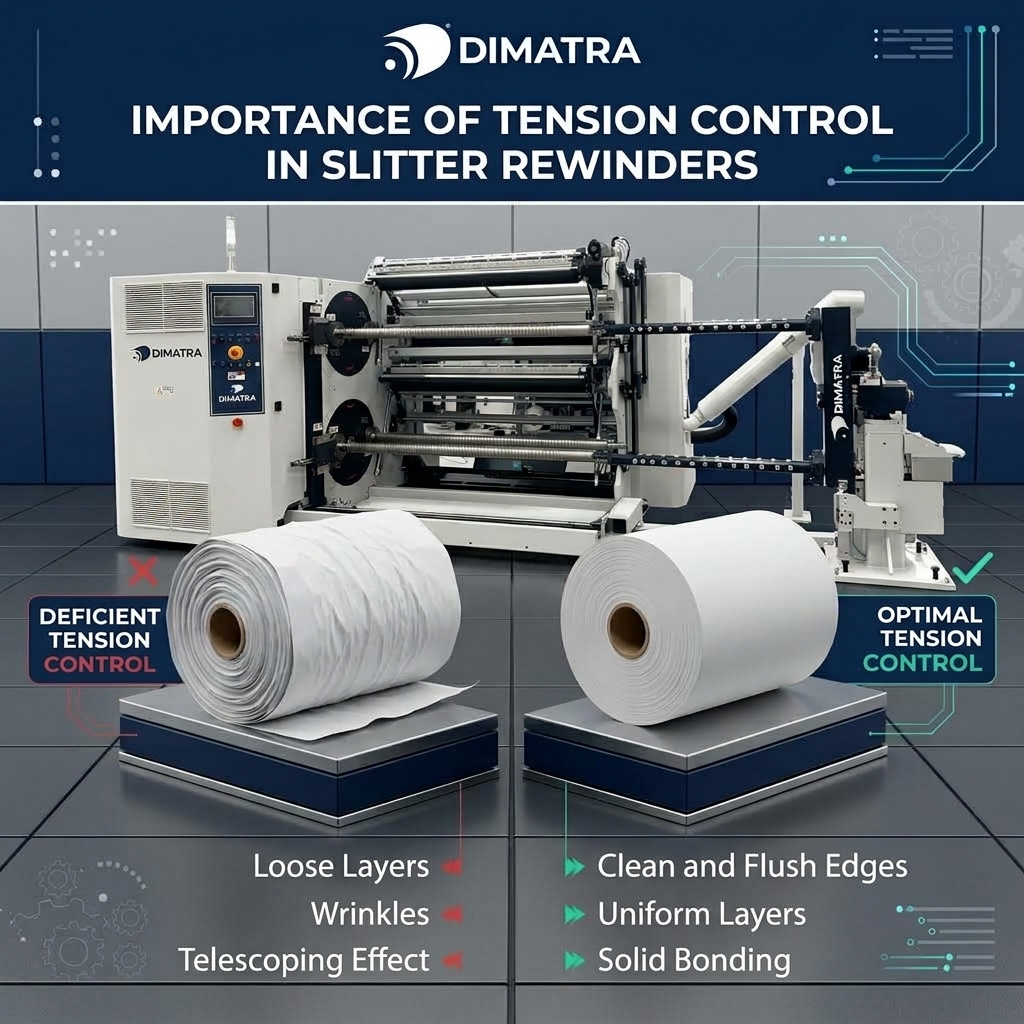
| Telescope | Layers shift axially and the roll takes on a cone-like shape | Insufficient or uneven tension, misaligned rollers, irregular cores, trapped air, gauge variations |
| Starred rolls | Layers near the core wrinkle, forming a star pattern | Excessive tension accumulated toward the center, missing or incorrectly adjusted taper |
| Wrinkles | Longitudinal or diagonal folds | Rollers out of parallel, tension differences across the web, irregular gauge |
| Trapped air | Soft rolls that “breathe” | Incorrect lay-on roller pressure, high speed with very smooth material, static electricity |
| Hard bands or wavy edges | Areas of the roll are tighter than others | Gauge variations across the web, poor slitting, uneven tension between slit rolls |
A useful diagnostic point: when the problem appears on every roll of the same width, it is usually related to the machine or its settings; when it appears only on some rolls, the source is often the master roll. Distinguishing between these two situations prevents hours of adjustments that lead nowhere.
Where Tension Is Gained or Lost Inside the Machine
A slitter rewinder is a chain: any weak link is reflected in the finished roll.
Unwinding. The master roll can weigh hundreds of kilograms and has considerable inertia. An unwinder with a properly sized brake or control system maintains stable input tension even as the diameter changes during the run. Shaftless unwinders with chucks speed up loading and eliminate the need to handle heavy shafts.
Web guiding. If the film enters misaligned, no amount of tension can correct it. A web guiding system with an edge sensor or print-mark sensor maintains the web position through the slitting process. For transparent or unprinted materials, the proper edge sensor is essential.
Static control. Anti-static bars are often considered an accessory, but static charge attracts dust, causes layers to adhere irregularly, and contributes to trapped air.
Slitting system. Razor slitting is common for thin films because of its clean cut and low operating cost; circular knife slitting is preferred when the material is thicker, laminated, or more demanding. A clean edge rewinds better than an edge with burrs.
Rewinding with differential shafts. This is where a significant part of the final quality is determined. In a duplex machine, the slit rolls are distributed alternately between two shafts, so adjacent rolls do not rub against each other. Differential friction shafts allow each roll to rotate with its own slip and maintain its own tension, which is important because small gauge variations across the web cause each slit roll to build up at a slightly different rate. Without this compensation, thicker rolls become tighter while thinner rolls become looser.
Tension taper. As the roll grows, rewinding tension should decrease according to a programmed curve. If tension remains constant, the outer layers compress the inner layers, resulting in starring or core crushing.
Low-inertia rollers. Lightweight, low-friction rollers respond better to speed changes and help prevent tension peaks during acceleration and deceleration.
What Dimatra Duplex Slitter Rewinders Incorporate
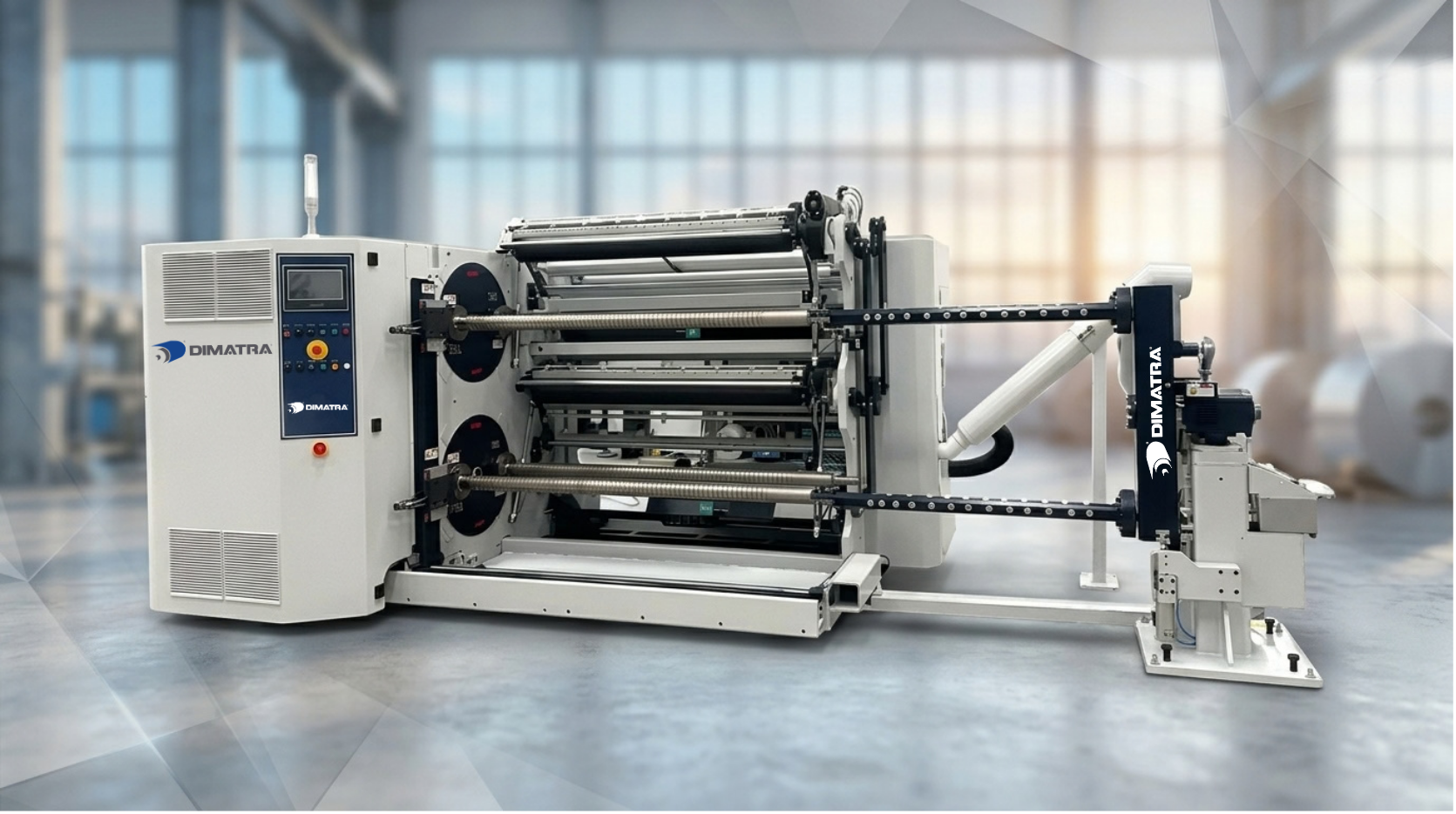
Dimatra designs and manufactures duplex slitter rewinders in León, Guanajuato, Mexico, for plastic film, paper, and other flexible materials. Two of its models illustrate how the principles described above are translated into machine features.
The Compact Duplex, with its compact design and easy operation, processes cellophane, PET, PE, PVC, BOPP, CPP, BOPA, PP, laminates, label stock, and paper. It incorporates a shaftless unwinder for 3″ cores, web guiding, razor slitting, 3″ differential friction shafts, and low-inertia, low-friction rollers. Optional features include a master-roll lifting table (patented system), circular knife slitting, trim removal, anti-static bars, a laser for core positioning, and remote connection for diagnostics.
The Duplex 1000 is designed for higher production requirements. It adds a splicing table with upper and lower presses, print-mark sensor web guiding, six razor knives, 3″ differential shafts with independent drive for each shaft, a central support for the rewinding shafts, automatic unloading, and automatic stops based on length or diameter. Its tension taper system is designed to ensure the quality of the finished product.
| Feature | Duplex Compact | Duplex 1000 |
|---|---|---|
| Unwind diameter | 1,000 mm | 1,000 mm (1,300 mm option) |
| Standard widths | 1,000 / 1,300 / 1,600 mm | 1,000 / 1,300 / 1,600 mm |
| Rewind diameter | 600 or 800 mm | 1,000 mm |
| Maximum speed | 500 or 750 m/min | 800 m/min |
| Minimum slit width | 38 mm | 38 mm |
In both cases, Dimatra provides training, installation, spare parts, preventive maintenance, and a support line to help resolve issues. With equipment of this nature, this support is just as important as the specifications, because rewinding quality also depends on the operator’s ability to properly adjust the machine.
Best Operating Practices
Even the best machine requires discipline. Some practices commonly found in high-performing plants include:
- Document recipes by material, gauge, and width: unwinding and rewinding tension, taper, and roller pressure.
- Change one variable at a time during testing and record the result.
- Check the condition of the master roll (core, edges, gauge) before blaming the machine.
- Keep knives sharp and properly calibrated: poor slitting creates edge defects that can look like tension problems.
- Periodically check roller parallelism and cleanliness.
- Train all shifts using the same criteria so that quality does not depend on who is operating the machine.
How to Evaluate a Slitter Rewinder Before Buying
When comparing equipment, it is worth looking beyond the published speed and width specifications. Questions worth asking the supplier include:
- What materials and gauge ranges have been validated on the machine?
- How is tension controlled during unwinding and rewinding, and can it be configured by material?
- Is the taper adjustable? Can recipes be saved?
- What slitting system is included, and what options are available for the specific material?
- How is the rewinding of multiple slit rolls handled: differential shafts, central support, unloading?
- How quickly can the machine be changed over from one roll and width to another?
- What does the service package include: training, installation, spare parts, remote support?
It is worth requesting a trial using your own material. No technical datasheet can replace seeing how the actual roll performs.
Conclusion
Tension control is not merely an adjustment detail; it is the foundation of quality in slitting and rewinding. Understanding how material, gauge, speed, and machine characteristics interact makes it possible to diagnose defects more effectively and select equipment that responds to the plant’s actual operating conditions.
At Dimatra, with decades of experience designing and manufacturing converting machinery, we support this process from equipment selection through commissioning. If you would like to review your application with a specialist, contact us.
Have you experienced tension problems with your converting machinery?
