


Slitting and rewinding heavy-gauge plastic films requires different processing conditions than those used for conventional thin films. As material thickness increases, so do the mechanical demands placed on the machinery, particularly on the drive system, cutting components, and tension control systems.
For manufacturers working with films for thermoforming, agricultural applications, and other industrial processes, selecting the right slitter rewinder is essential. The right equipment helps maintain production stability, achieve consistent cuts, and ensure high-quality finished rolls.
In this article, we explore the main challenges of processing heavy-gauge films, explain the features a specialized machine should have, and show how DIMATRA’s Duplex Compact Slitter Rewinder for Heavy-Gauge Film addresses these requirements.
What Does Slitting and Rewinding Heavy-Gauge Film Involve?
Slitting and rewinding is a converting process in which a parent roll is unwound, slit longitudinally into narrower widths, and rewound into individual finished rolls.
Although this process is common throughout the converting industry, working with heavy-gauge plastic films presents specific challenges.
Unlike thin films, thicker materials may require higher tension levels and greater mechanical capacity to maintain stable material movement and achieve proper cutting performance.
For this reason, selecting a slitter rewinder should not be based solely on working width or rated speed. Manufacturers must also consider material properties, thickness, roll weight, and finished-roll requirements.
Main Challenges in Processing Heavy-Gauge Plastic Films
Achieving a stable and productive process requires careful attention to four key areas.
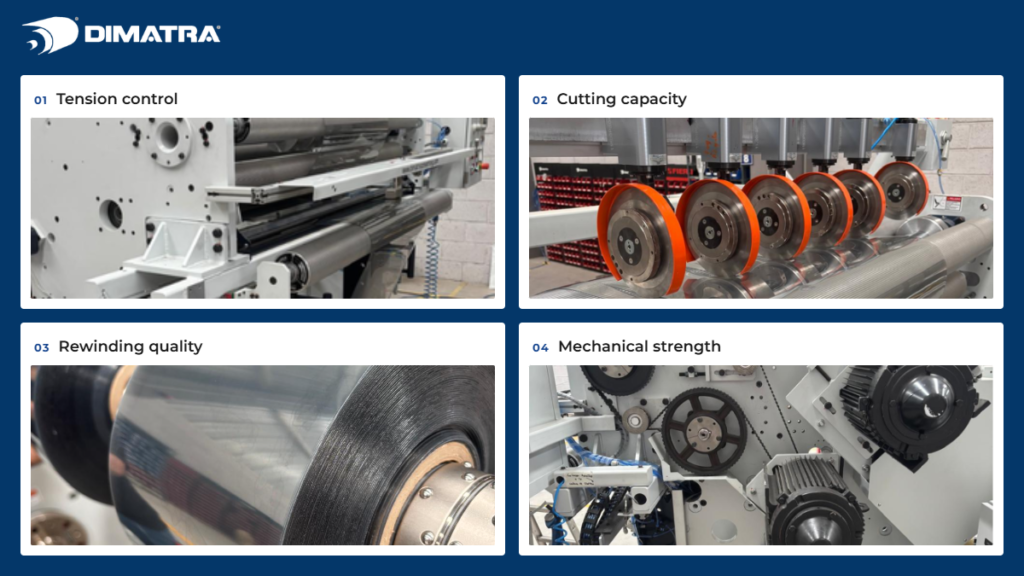
1. Tension Control Throughout the Process
Tension control is one of the most important factors in any slitting and rewinding operation.
During unwinding, material transport, and rewinding, tension must remain within the appropriate operating range. When processing heavy-gauge films, the machine needs a drive system capable of delivering the required force to maintain stable material movement.
Without sufficient mechanical capacity, process stability can be compromised, making it difficult to achieve uniform finished rolls.
Furthermore, tension settings must be adjusted according to the mechanical properties and specific characteristics of each material.
2. Cutting System Capacity
Material thickness directly affects the demands placed on the cutting system.
While certain thin films can be processed using conventional configurations, thicker materials require more robust blades, knife holders, and mechanical components.
Consequently, the cutting system must provide sufficient capacity to produce clean, consistent longitudinal cuts while minimizing irregularities along the material edges.
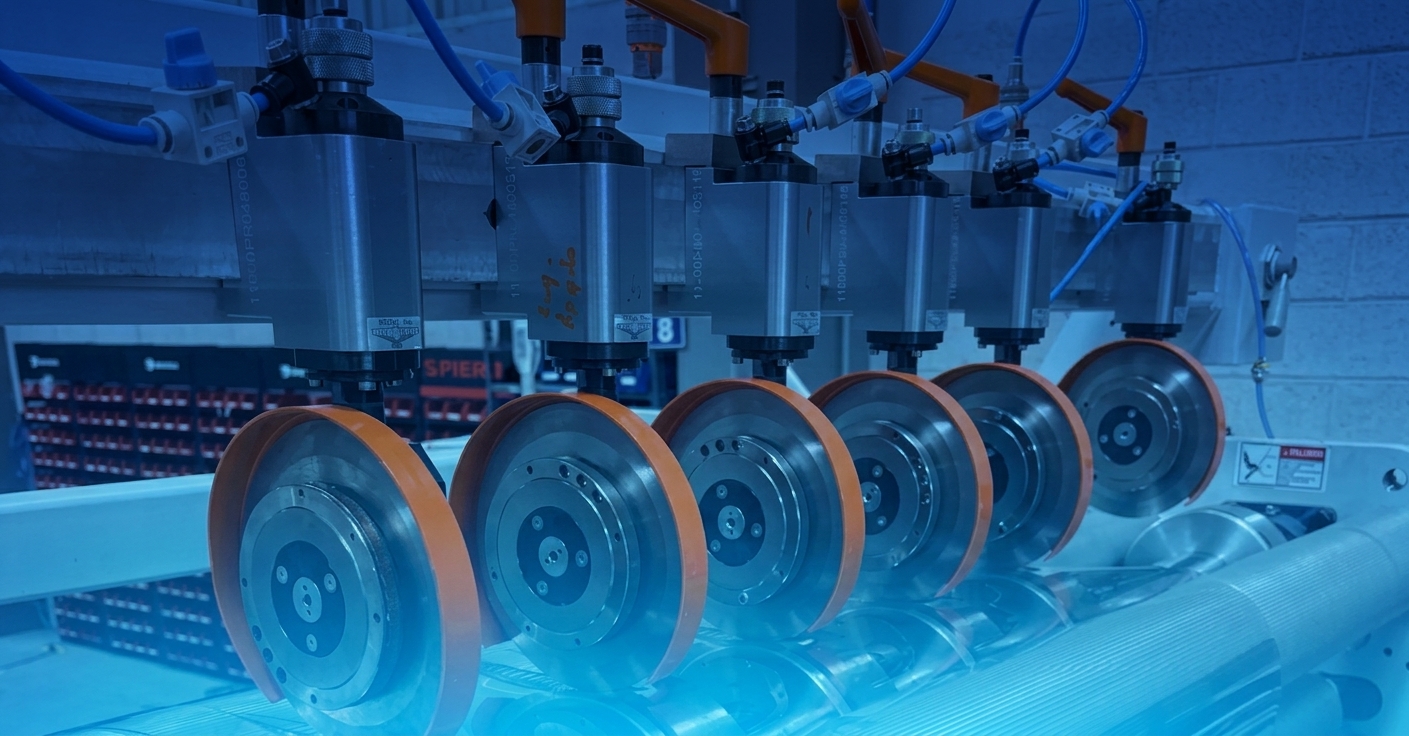
One solution for these applications is shear slitting. This method uses a circular knife and a counterknife to cut the material through a shearing action.
3. Rewinding Quality
Achieving a clean cut is not enough if the finished rolls lack uniform winding quality.
During rewinding, tension variations between individual slit lanes can result in differences in roll tightness and structure. As a result, roll appearance and handling can be affected.
Differential winding shafts help address this challenge by allowing independent tension adjustments across the individual rolls wound on the same shaft.
In addition, this system helps compensate for minor variations in material gauge, contributing to better-formed finished rolls.
4. Machine Strength and Mechanical Capacity
Heavy-gauge films can place considerable loads on slitter rewinder components.
Therefore, the drive system, motors, rollers, and supporting components must be properly sized for the intended operating conditions.
Processing capacity does not depend solely on installed motor power. Instead, it relies on the coordinated performance of all the machine’s systems.
What Applications Require Heavy-Gauge Film Slitting?
Heavy-gauge film slitting and rewinding serves several industrial sectors that require precise material conversion.
Common applications include:
Thermoforming Films
These materials are used in the manufacturing of containers, trays, packaging, and various plastic products. Typically supplied in rolls, they undergo slitting operations before moving on to subsequent thermoforming processes.
Agricultural Greenhouse Films
Plastic films used in agricultural applications require converting operations to achieve the widths and formats needed for specific installations.
Plastic Films for Pet Protective Cones
Films used to manufacture veterinary protective cones may also require slitting and rewinding to obtain the appropriate widths for subsequent processing.
Each application has its own requirements. Therefore, material thickness, rigidity, composition, and mechanical behavior must be evaluated to determine the appropriate machine configuration.
To learn more about thermoforming and its industrial applications, visit the British Plastics Federation’s technical resource on thermoforming.
DIMATRA’s Duplex Compact Slitter Rewinder for Heavy-Gauge Film
At DIMATRA, we developed a specialized configuration of our Duplex Compact Slitter Rewinder to meet the demands of heavy-gauge film processing.
This version is engineered to process plastic films up to 2 mm thick, depending on the material’s characteristics and operating conditions.
To achieve this, the machine combines a high-capacity drive system, a robust cutting system, and differential rewinding technology. Together, these components provide the mechanical capacity required for stable and productive operation.
Key Technical Features
Drive System Designed for High Tension
The machine features a dual-drive system engineered to handle high tension levels. As a result, it provides the mechanical capacity required for processing heavy-gauge materials.
Shear Slitting System
It features a shear slitting system equipped with six knife holders and six counterknives. Additionally, its specially designed, heavy-duty cutting blades are intended for processing thicker materials.
Differential Rewinding Shafts
The machine incorporates two differential rewinding shafts that allow independent tension adjustments on each shaft. This helps maintain uniform tension across the individual slit rolls.
Shaftless Unwinder
The shaftless unwinding system uses pneumatic expanding chucks to secure the parent roll. Consequently, roll loading is simplified while providing support during operation.
Web Guiding System
An integrated web guiding system uses an edge sensor and electromechanical actuator to maintain proper material alignment throughout the process.
General Technical Specifications
| Feature | Capacity |
|---|---|
| Maximum working width | 1,600 mm |
| Maximum material thickness | Up to 2 mm* |
| Maximum unwind diameter | 1,000 mm |
| Maximum rewind diameter | 600 mm |
| Maximum unwind roll weight | 1,000 kg |
| Maximum speed | 200 m/min |
| Cutting system | Shear slitting |
| Rewinding system | Differential shafts |
Maximum speed and processing capacity depend on material type, thickness, and condition. The feasibility of each application must be confirmed through a technical evaluation by DIMATRA.
Why Is It Important to Choose a Specialized Slitter Rewinder?
Selecting a slitter rewinder should always start with an evaluation of the actual material to be processed.
A machine designed for thin films does not necessarily have the mechanical capacity, cutting system, or drive configuration required for heavy-gauge applications.
Before selecting a machine, manufacturers should evaluate the following:
- Material type: Composition and mechanical properties.
- Thickness: Minimum and maximum gauges to be processed.
- Working width: Parent roll dimensions and required slit widths.
- Roll weight and diameter: Unwinding conditions and rewinding capacity.
- Production speed: Required output based on manufacturing needs.
- Finished roll specifications: Required diameter, width, and roll quality.
In addition, testing material samples is recommended for specialized applications. This helps validate process feasibility and determine whether additional components or machine configuration changes are required.
For further information on the fundamentals of tension control in industrial web handling applications, refer to Mitsubishi Electric’s technical guide on tension control systems.
DIMATRA: Solutions for Industrial Film Slitting and Rewinding
Processing heavy-gauge films requires machinery engineered to meet specific operating conditions.
At DIMATRA, we design and manufacture slitter rewinders for a wide range of applications in the plastic film, paper, and nonwoven industries.
Our Duplex Compact Slitter Rewinder for Heavy-Gauge Film is a specialized solution for manufacturers who need to process thick materials using a high-capacity drive system, a robust cutting system, and rewinding technology designed to deliver high-quality finished rolls.
Looking for a solution to slit and rewind heavy-gauge plastic films?
At DIMATRA, we can help evaluate your material specifications and determine the right machine configuration for your production process.
Contact us to learn more about our Duplex Compact Slitter Rewinder for Heavy-Gauge Film.
