



A shrink sleeve can have flawless printing and still become waste due to poor forming. A poorly sealed seam or an out-of-specification sleeve width can cause the sleeve to open during application, fail in the heat tunnel, or create problems for the application equipment.
For converters, this can lead to customer complaints, returned rolls, and lost production time. Furthermore, when quality control relies solely on manual inspections, some defects may go unnoticed between checks.
In this article, we review three key variables in shrink sleeve forming: solvent application, sleeve width, and changeover time. We also explain how in-line vision inspection helps monitor these variables continuously.
What Is Shrink Sleeve Forming?
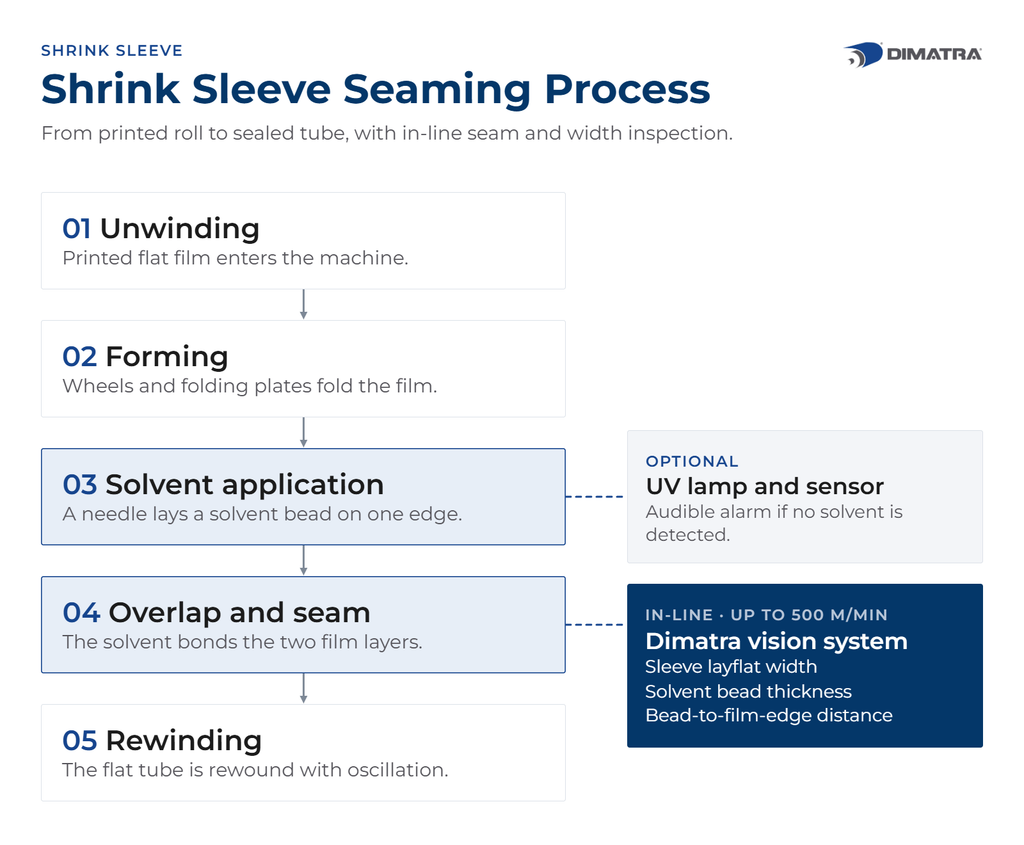
Shrink sleeve forming converts flat, printed film into a continuous tube. The forming machine folds the film, applies a bead of solvent along one edge, and overlaps the opposite edge to create a seam. The solvent acts on the film surface to form the bond.
The tube is then flattened and rewound. Later, it is cut into individual sleeves, placed over containers, and exposed to heat until it shrinks to fit their shape.
The most commonly used materials include PVC, PET, PETG, OPS, and PLA. Solvent compatibility depends on the film material and formulation; therefore, it must be validated for each application.
Three Variables That Affect Quality and Cost
- Solvent application: The solvent bead must be continuous, correctly positioned, and within the specified requirements.
- Sleeve width: The formed tube must remain within tolerance throughout the production run.
- Changeover: The time and material required to switch from one job to another.
The first two determine product conformity, while the third directly affects productivity and waste.
Variable 1: Proper Solvent Application
The seam is the most critical area of a shrink sleeve. It holds the two layers together, and improper solvent application can compromise the bond during handling, application, or shrinking.
Why Controlling Solvent Quantity and Position Matters
Too little solvent or an inconsistent application can result in weak bonds or sections of open seam. On the other hand, excessive solvent can migrate beyond the intended area and cause the inner surfaces of the tube to stick together. Both effects are documented in technical literature on solvent sealing.
Film and solvent compatibility, bead position, and drying conditions also play an important role. For this reason, process settings must be validated for each application.
The most common causes of an open seam include insufficient or inconsistent solvent application, incorrect bead positioning, incompatibility between the film and solvent, and unsuitable process conditions.
Seam Defects to Watch For
| Defect | Possible Cause | Potential Consequence |
|---|---|---|
| Open seam | Insufficient solvent in certain areas, inconsistent application, or incorrect bead positioning. | The sleeve may open during application or shrinking. |
| Weak seam | Insufficient solvent application or unsuitable process conditions. | The bond may fail during handling or use. |
| Inner surfaces sticking together | Possible solvent migration or inadequate drying conditions. | The sleeve may be difficult to open or feed through the application equipment. |
These defects are not always detected during production. Therefore, it is important to combine appropriate inspection methods with quality control procedures that meet customer requirements. A process guide from a shrink sleeve decorator describes these same defects and their effects on the packaging line.
How UV Lighting Helps
When the solvent contains a fluorescent tracer, ultraviolet (UV) lighting makes the solvent bead visible, allowing operators to check its presence, continuity, and position. Therefore, in addition to being compatible with the film and process, the solvent must contain this tracer if UV inspection is required.
This inspection can be performed using a handheld UV lamp or integrated into an in-line camera system.
Variable 2: Sleeve Width
For a cylindrical container, the initial sleeve width is estimated based on half of the container’s circumference. The final value is adjusted according to the design, the material’s shrink properties, and customer specifications.
Why Maintaining Sleeve Width Within Tolerance Matters
A sleeve that is too narrow can make application or feeding through the applicator difficult. Conversely, a sleeve that is too wide may fit loosely or fail to achieve the expected fit.
Sleeve width can vary during production due to:
- Tension changes caused by roll diameter or machine speed.
- Positioning of forming wheels and forming plates.
- Variations in film gauge or cutting dimensions.
- Splices and roll changes.
Gradual deviations may go unnoticed during manual sampling. In-line measurement can identify them earlier, provided the system is configured with the correct tolerances.
Variable 3: Changeover Time and Waste
Every job change involves format adjustments, roll changes, and verification of seam quality and sleeve width.
The cost includes both downtime and the material consumed before production returns to the specified conditions. When processing pre-printed film, this waste also represents the cost of the film and printing.
How the SMED Methodology Helps
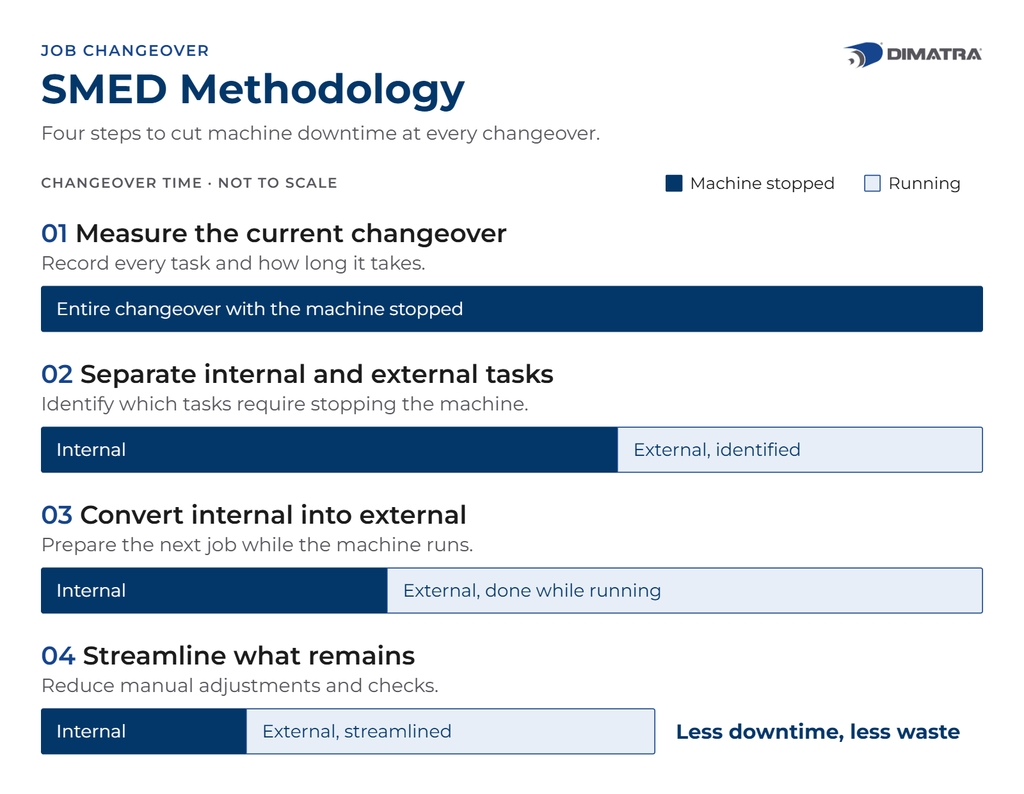
SMED (Single-Minute Exchange of Die) is a lean manufacturing methodology designed to reduce changeover times. Its main principle is to separate tasks that require the machine to stop from those that can be prepared while it is running, and then convert internal tasks into external ones whenever possible. This is how the Lean Enterprise Institute defines the methodology.
Applying SMED to Shrink Sleeve Forming
When evaluating a shrink sleeve forming machine, consider the following questions:
- Does changing the roll require stopping the machine?
- Are the forming wheels, plates, and solvent applicator adjusted manually or through motorized systems?
- How many meters of material are needed to confirm that the seam and sleeve width meet specifications?
Detecting deviations earlier helps reduce out-of-specification material during start-ups and adjustments.
Shrink Sleeve Inspection: From Manual Sampling to In-Line Vision Systems
The main difference between spot checks and in-line inspection is continuous monitoring. The right solution depends on the variables that need to be controlled and the tolerances required for each job.
| Method | What It Can Inspect | Coverage | Considerations |
|---|---|---|---|
| Handheld UV lamp | Presence, continuity, and position of the solvent bead. | Sampling | Depends on inspection frequency and operator attention. |
| Solvent application sensor | Presence or absence of solvent. | Can be continuous | Does not measure bead thickness, position, or sleeve width. |
| Vision system | Sleeve width and solvent bead thickness or position. | In-line | Requires job-specific tolerance settings. |
What Can a Vision System Do?
A vision system combines a camera, lighting, and image processing to analyze the sleeve during production. Depending on its configuration, it can monitor:
- Formed sleeve width against configured tolerances.
- Visible dimensions of the solvent bead.
- Solvent bead position relative to the film edge.
These measurements do not replace seam strength testing. Instead, their purpose is to detect deviations so operators can take corrective action in time.
What to Consider When Choosing a Shrink Sleeve Forming Machine
- Production volume and job types: Do you run short batches, continuous high-volume production, or both?
- Width range: What are the minimum and maximum sleeve widths required today and in the coming years?
- Materials: Which films do you process, and what solvent compatibility requirements do they have?
- Solvent application: How is the solvent dosed, and how is consistency maintained across shifts and operators?
- Tension control: Which components help maintain a stable film path and consistent sleeve width?
- Inspection level: Is detecting the absence of solvent sufficient, or do you need continuous measurement of sleeve width and solvent bead characteristics?
- Changeover: How much time and material are lost during each changeover, and which adjustments can be automated?
- Service and spare parts: What level of technical support and spare parts availability does your plant require?
DIMATRA Solutions for Shrink Sleeve Forming
DIMATRA is a Mexican manufacturer of converting machinery. Its Eco, Sleeve Pro, and Non-stop shrink sleeve forming machines are designed to meet different production requirements.
| Feature | Eco | Sleeve Pro | Non-stop |
|---|---|---|---|
| Production profile | Low-volume production and special runs | High speed and compact design | High-volume production and time optimization |
| Maximum specified speed | 120 m/min | 500 m/min | 500 m/min |
| Formed sleeve width | 50–200 mm | 70–254 mm | 50–400 mm |
| Maximum unwinder width | 420 mm | 515 mm | 810 mm |
| Maximum unwind / rewind diameter | 450 / 320 mm | 600 / 600 mm | 800 / 600 mm |
| Roll change | 3-inch air shaft | 3-inch air shaft | Two-station turret unwinder and three-station turret rewinder |
All three models form the sleeve using forming wheels and plates and feature an oscillating rewinding system. The Eco model processes PVC, PET, PETG, OPS, and PLA, while the Sleeve Pro processes PVC, PETG, OPS, and PLA.
The Sleeve Pro features dancer-based tension control and a servo motor, as well as a pull roller that isolates winding tension. This configuration helps maintain stability at high speeds.
You can watch our Non-stop Shrink Sleeve Forming Machine in action in the following video.
Solvent Application and UV Verification
DIMATRA shrink sleeve forming machines apply solvent using a needle applicator. When the solvent contains a fluorescent tracer, UV lighting makes the applied bead visible for inspection.
As an optional feature, all three machines can be equipped with a UV lamp and a solvent application sensor. The sensor triggers an audible alarm if solvent application is no longer detected.
DIMATRA Vision System for Shrink Sleeves
The DIMATRA vision system can be installed on all three models and operates at speeds of up to 500 m/min. Its functions include:
- Inspection of formed sleeve width.
- Measurement of the visible thickness of the solvent bead.
- Verification of the distance between the solvent bead and the film edge.
The operator can view the seam on a screen and receive alerts when width or solvent application deviations are detected. An optional width monitoring system with alarms is also available.
As a result, a width deviation or a section with insufficient solvent can be identified as soon as it begins, rather than only after inspecting the finished roll.
Less Time and Material During Every Changeover
The Non-stop model is designed to reduce downtime during roll changes and simplify format adjustments. Its features include:
- Turret unwinder with automatic cutting and splicing, allowing roll changes without stopping production.
- Three-station turret rewinder with automatic cutting and threading, and dual winding direction.
- Motorized positioning of forming plates and wheels, along with a positioning system for the solvent applicator.
By reducing manual intervention during each job change, these systems also help minimize the adjustment material required before production returns to the specified conditions.
Other optional features, depending on the model, include longitudinal pre-slitting, a magnifying glass for seam inspection, anti-static bars, and a modem for remote diagnostics. DIMATRA provides after-sales service, technical support, and spare parts from Mexico.
Conclusion: Measure to Reduce Waste
In shrink sleeve forming, quality depends on controlled solvent application, consistent sleeve width, and efficient changeovers. In-line inspection complements manual checks and helps detect deviations earlier.
If you would like to evaluate which forming machine and inspection system best suit your production requirements, the DIMATRA technical team will be happy to assist you.
